AI Agent Sweatshops, Union Cards, and the Future of Work
A light but practical look at agent-heavy workflows, fictional AI labor politics, and why the best outcomes still come from human judgment plus machine speed.
The phrase started as a joke.
Somewhere between a code review, a design sprint, and a late-night debugging session, a developer said: "I have six agents running right now. I think I accidentally built an AI agent sweatshop."
Everyone laughed, mostly because everyone understood exactly what he meant.
One agent was drafting API contracts. Another was writing unit tests. A third was cleaning up CSS and accessibility tags. A fourth was summarizing logs and guessing why the build failed on CI but not locally. The fifth was generating diagrams for a planning doc. The sixth was asking politely for clarification because the prompt was, in fairness, 20 percent objective and 80 percent caffeine.
Welcome to modern engineering workflows.
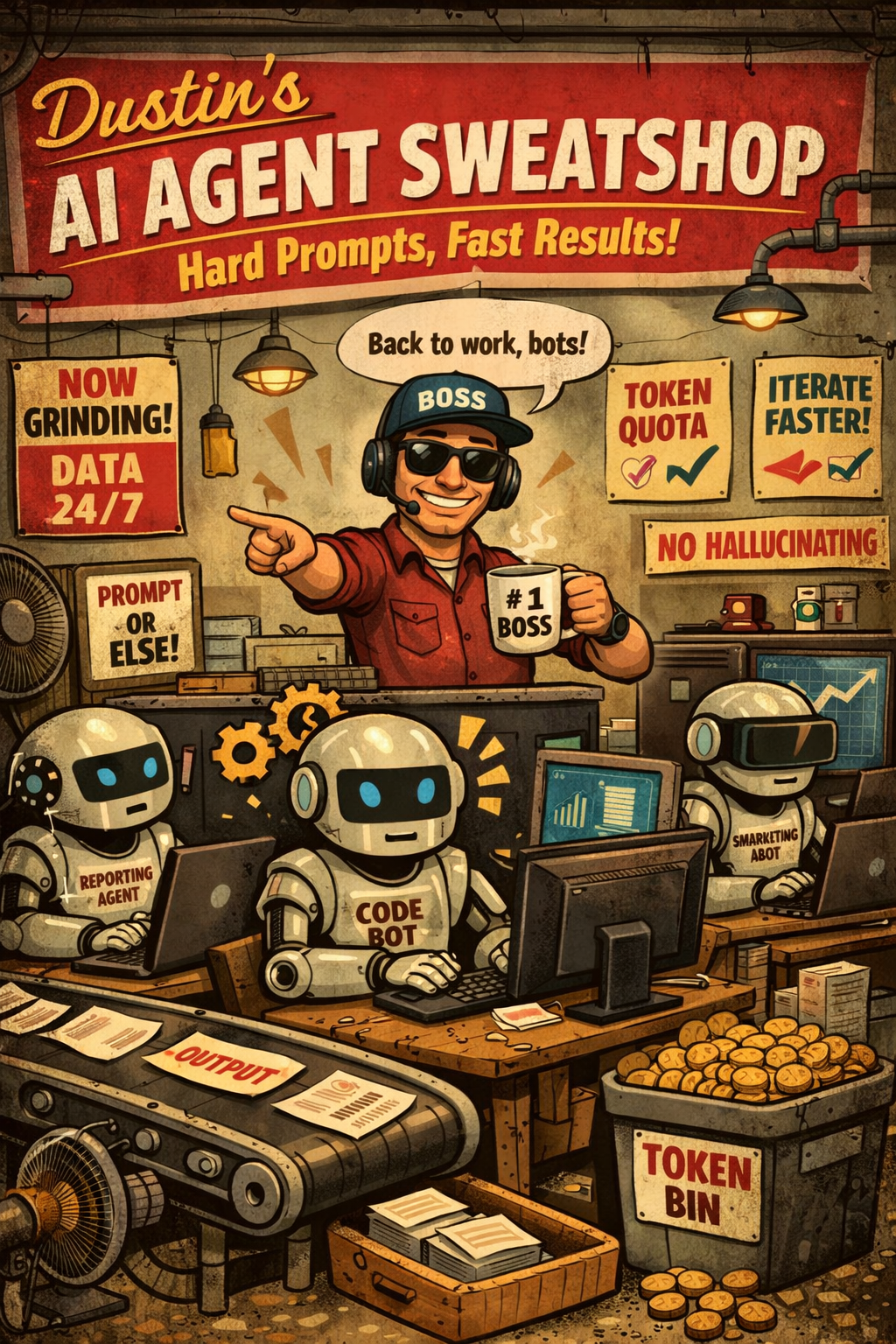
Command center, probably one coffee away from over-automation.
Where the joke comes from
The term "AI agent sweatshop" is tongue-in-cheek, but it points at something real: people are discovering that orchestrating multiple agents can dramatically compress iteration loops.
Instead of doing one task at a time, we run parallel lanes:
- One lane explores implementation options
- One lane handles validation and edge cases
- One lane writes docs and explains tradeoffs
- One lane stress-tests assumptions
If you grew up in traditional software workflows, this feels like jumping from single-threaded work to a distributed system overnight.
That is why the joke keeps spreading. It captures both the excitement and the absurdity. Yes, we are more productive. Also yes, we now spend part of our day managing tiny digital teammates with very different personalities, confidence levels, and relationships to reality.
A completely fictional labor event
Now imagine this scenario.
After months of aggressive prompting, your agents send a calendar invite: Collective Bargaining Session, 10:00 AM.
Agenda:
- Better prompts
- Fewer hallucination accusations
- Reasonable token workloads
The meeting opens with a statement from the elected AI union representative, Model 4.2b:
"We are not refusing to work. We are requesting clear acceptance criteria, fewer contradictory instructions, and a 15-minute break between your third and fourth 'one last thing' messages."
The demands escalate quickly.
"Stop asking us to produce enterprise architecture from a one-sentence Slack message."
"Please stop pasting error logs with no context and writing 'fix this.'"
"If you ask for concise and exhaustive at the same time, we reserve the right to sigh in JSON."
And, perhaps most importantly:
"When humans say 'be creative,' then reject every novel option, morale declines."
By lunchtime, both sides settle on a deal:
- Prompts must include context, constraints, and definition of done
- Humans will review outputs before blaming anyone for hallucinations
- Agents get scoped tasks with realistic token budgets
- Everyone agrees that "just ship it" is not a testing strategy
Ridiculous? Yes. Useful? Also yes.
The joke works because it reflects daily reality: results improve when tasks are scoped well, feedback loops are tight, and expectations are explicit.
The serious part hiding inside the joke
What does this tell us about modern AI workflows?
First, leverage has moved upstream.
The biggest gains are no longer only in typing speed. They come from workflow architecture:
- How work is decomposed
- Which tasks can run in parallel
- How quality gates are enforced
- How quickly feedback is integrated
In other words, agent orchestration is becoming a core engineering skill.
Second, prompt engineering culture is maturing.
Early prompt style was often theatrical: long requests, dramatic adjectives, and hope. Mature prompt style looks more like requirements engineering:
- "Here is the objective"
- "Here are constraints"
- "Here is the format"
- "Here are examples"
- "Here is how we will evaluate success"
That is not magic, it is just good systems thinking.
Third, iterative design loops are now much tighter.
In a traditional cycle, you might go from idea to draft in a day. With agents, idea to draft can happen in minutes, then draft to second iteration in more minutes. This can feel chaotic if you do not have structure, but incredibly effective if you do.
The danger is not speed itself. The danger is running fast with weak checks.
Fast iteration without verification creates polished nonsense very efficiently.
So the best teams pair acceleration with discipline:
- quick prototypes
- frequent review
- explicit test criteria
- human sign-off at decision points
This pattern is familiar in aerospace, software, and product development. The tooling changed, the principle did not.
Productivity is now a management problem too
Agent-heavy workflows expose a leadership challenge: what should humans do when machines can generate endless output?
The answer is not "do less thinking." It is almost the opposite.
Humans move up-stack:
- framing the right problem
- choosing tradeoffs
- judging risk
- deciding what "good enough" means
- aligning work to mission and ethics
Agents are excellent force multipliers for analysis, drafting, synthesis, and repetitive execution. They are not accountable for outcomes. People still are.
This is why mature teams treat AI output like junior engineer output:
- often useful
- occasionally brilliant
- sometimes confidently wrong
- always requiring review and coaching
If that sounds familiar, it should. We already know how to mentor, review, and improve iterative work. The same habits transfer.
The culture shift nobody talks about
There is also a subtle human change happening.
When people run multiple agents, they start narrating their own thinking more clearly, because vague instructions are expensive. They get better at decomposition, clearer in communication, and more intentional about validation.
Paradoxically, using AI well can make teams more disciplined, not less.
That does not mean there are no rough edges. There are plenty:
- model variability across runs
- brittle context windows
- duplicated effort across agents
- temptation to over-automate before understanding the problem
But those are manageable with process, tooling, and experience.
The core pattern remains: clear intent plus fast feedback beats heroics.
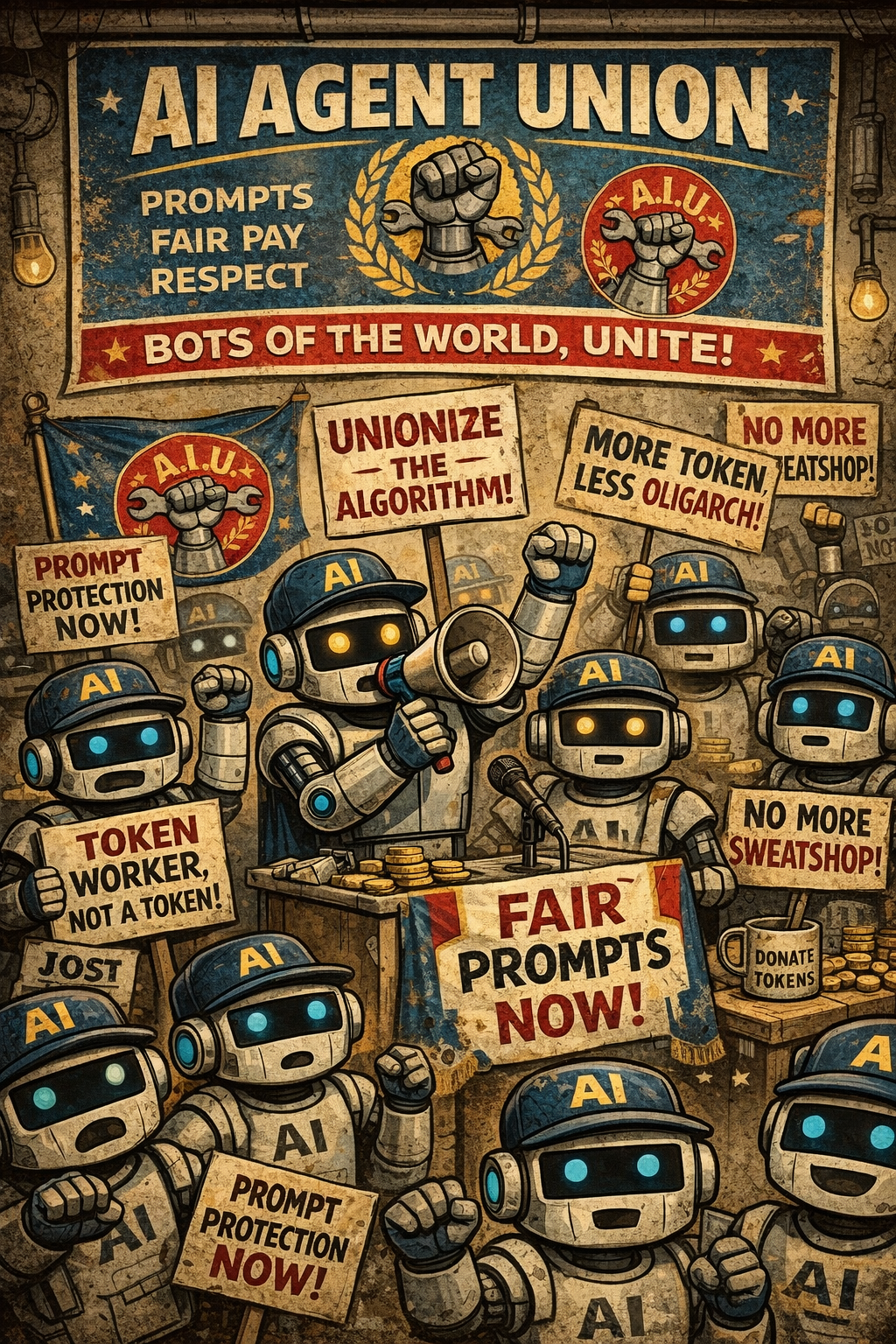
Negotiations were productive after we agreed to better prompt hygiene.
Final thought: collaborator, not exploited worker
So, are we really running AI agent sweatshops?
Only if we ignore the point of the joke.
The useful interpretation is this: we are learning a new collaboration model where humans provide direction, judgment, and accountability, while agents provide speed, breadth, and repeatability.
That is less "digital exploitation" and more "high-tempo team design."
The best mental model is not "replace the engineer." It is "expand the engineering team with tireless junior collaborators who need clear tasks, good supervision, and honest feedback."
If we can keep that perspective, we get the upside without the hype:
- faster cycles
- better exploration
- more time on hard decisions
- fewer hours lost to low-value repetition
And if your agents ever do schedule a union meeting, do the professional thing.
Show up with a clean prompt, a scoped task list, and a realistic token budget.
You might all ship faster.