AI Won't Replace Engineers - But It Will Change How We Build
AI is a tool, not a replacement for engineers. It will remove routine work and push teams toward higher-value judgment, creativity, and system thinking.

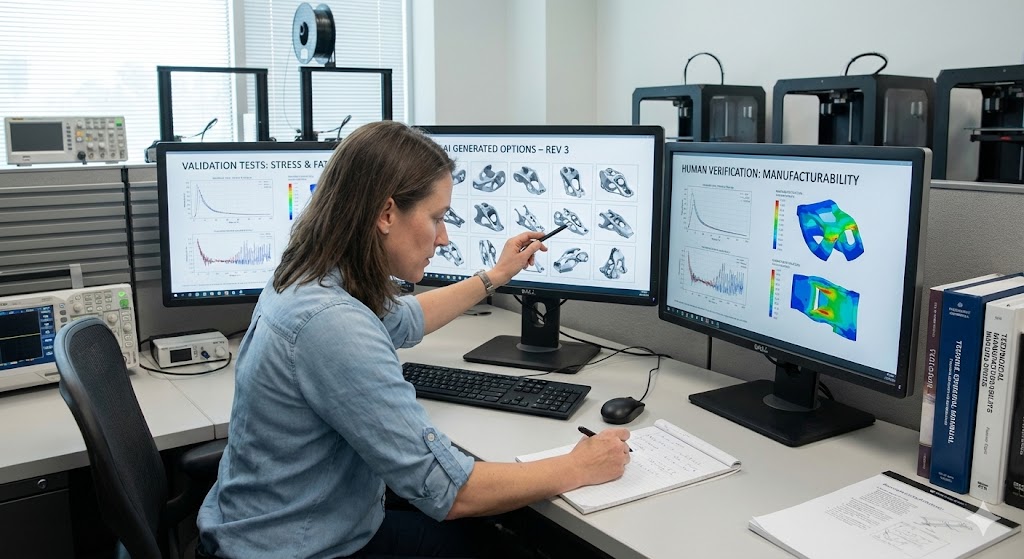
The question I hear most often is, "Will AI replace engineers?"
The short answer is no.
The more useful answer is this: AI is a tool, and like every major engineering tool, it changes the work more than it erases the profession.
That distinction matters.
The calculator lesson still applies
When calculators became mainstream, many people worried about two things:
- People would forget how to do math.
- Math-related jobs would disappear.
Some of that fear was understandable. A machine could suddenly do arithmetic faster and with fewer mistakes than a person doing raw calculations by hand.
And yes, some tasks did disappear. Entire categories of repetitive manual calculation were reduced or automated.
But math did not die.
It moved up the stack.
People spent less time on rote computation and more time on modeling, problem framing, optimization, proof strategy, and creative applications. The calculator removed work people did not need to keep doing manually and created space for harder, higher-leverage work.
AI is creating a similar shift in engineering.
What AI removes first
In day-to-day engineering, AI is very good at accelerating repetitive output:
- Boilerplate code and scripts.
- First-draft documentation.
- Log summarization.
- Data wrangling helpers.
- Test skeletons and review checklists.
Those tasks still matter, but they are rarely the highest-value part of the job.
If we are honest, much of that work is cognitive overhead. Useful, necessary, and often tedious.
Tools should remove that overhead.
What becomes more valuable
As repetitive output gets cheaper, the value shifts to capabilities machines still do not own:
- Defining the right problem under real constraints.
- Choosing tradeoffs with incomplete information.
- Designing validation strategies.
- Understanding mission context and consequences.
- Making accountable decisions.
In other words, AI raises the premium on engineering judgment.
It does not remove the need for it.
Jobs do change, and that is not always bad
A hard truth: tools do eliminate certain job patterns over time.
That happened with calculators, CAD, compilers, CNC, cloud automation, and many other technologies.
But what typically disappears is low-leverage repetition, not the need for capable people.
The better pattern is skill migration:
- From manual production to supervision and integration.
- From isolated tasks to system-level reasoning.
- From output volume to decision quality.
The goal should not be to preserve every old task exactly as it was. The goal should be to keep people doing the work humans are best at.
The real risk is unverified confidence
The biggest AI risk in engineering is not obvious nonsense.
It is plausible output that sounds right and passes a quick glance, but has hidden bad assumptions.
That is where teams get hurt.
A generated answer can look polished while being wrong in edge cases, wrong in units, wrong in interfaces, or wrong in mission context.
So the operating rule has to be clear:
AI can draft. Engineers must validate.
If a team cannot explain why an output is valid, the output is not ready.
How high-performing teams will use AI
Teams that benefit most from AI usually do a few things consistently:
- They define constraints clearly before generation.
- They keep tests close to generated artifacts.
- They separate drafting speed from approval authority.
- They track assumptions and decision provenance.
- They measure outcomes, not novelty.
This turns AI from a demo tool into an engineering tool.
Why accountability stays human
Real systems eventually touch reality.
Aircraft fly or do not. Controls stay stable or do not. Mission outcomes are achieved or not.
No language model signs the flight release. No model accepts legal or ethical responsibility for deployment decisions.
That accountability remains human and organizational.
As long as that is true, engineers are not optional.
A practical mindset for adoption
If you are introducing AI into an engineering organization, a practical framing is:
- Treat AI like an accelerant, not an authority.
- Use it first where errors are cheap and feedback is fast.
- Expand only where verification is strong.
- Invest in prompt quality the same way you invest in requirements quality.
A good prompt is not a trick. It is a compressed engineering brief.
Closing thought
AI will replace some work. It should.
If a task is pure repetition with low creative value, it is a good candidate for automation.
That does not devalue engineering. It refocuses engineering.
The calculator did not end math careers. It removed manual calculation bottlenecks and pushed people toward more meaningful math.
AI is doing the same for engineering.
The teams that win will be the ones that let tools handle the routine, while humans focus on judgment, creativity, and responsible decisions.
TODO: Add two real team examples showing cycle-time gains and unchanged or improved defect rates after AI-assisted workflow adoption.