Closed-Loop Whole-House Fan
Autonomous control for a QuietCool whole-house fan: an ESP32 reads temperatures, learns how the house heats and cools, forecasts the evening, and runs the fan over its own 433 MHz radio.
Problem / context
A whole-house fan is the cheapest way to cool a house on the Central Coast — pull cool evening air in, push hot attic air out — but only if it runs at the right time. Doing that by hand means watching indoor and outdoor temperatures all evening. I wanted the fan to decide for itself, with no cloud service and no hub in the loop.
Approach
A LILYGO LoRa32 (ESP32 + SX1278) learns the QuietCool wall remote's ID, then transmits as that remote on the fan's native 433.92 MHz link — the fan's receiver is never touched and the wall remote keeps working. The controller (fan_brain, plain C++17) keeps a learned thermal model of the house, a forecast of the evening, a run planner, and a safety supervisor so it does not short-cycle.
It reads indoor and outdoor temperatures straight from the ecobee cloud on the board itself — the same web login Home Assistant uses, no developer key — with a "windows open" arm that disarms itself at 9 a.m. so the fan never runs against a closed house. The RF component (joyfulhouse/esphome-quietcool) is used unmodified and pinned to a commit; this project adds the brain and the sensing.
The dashboard
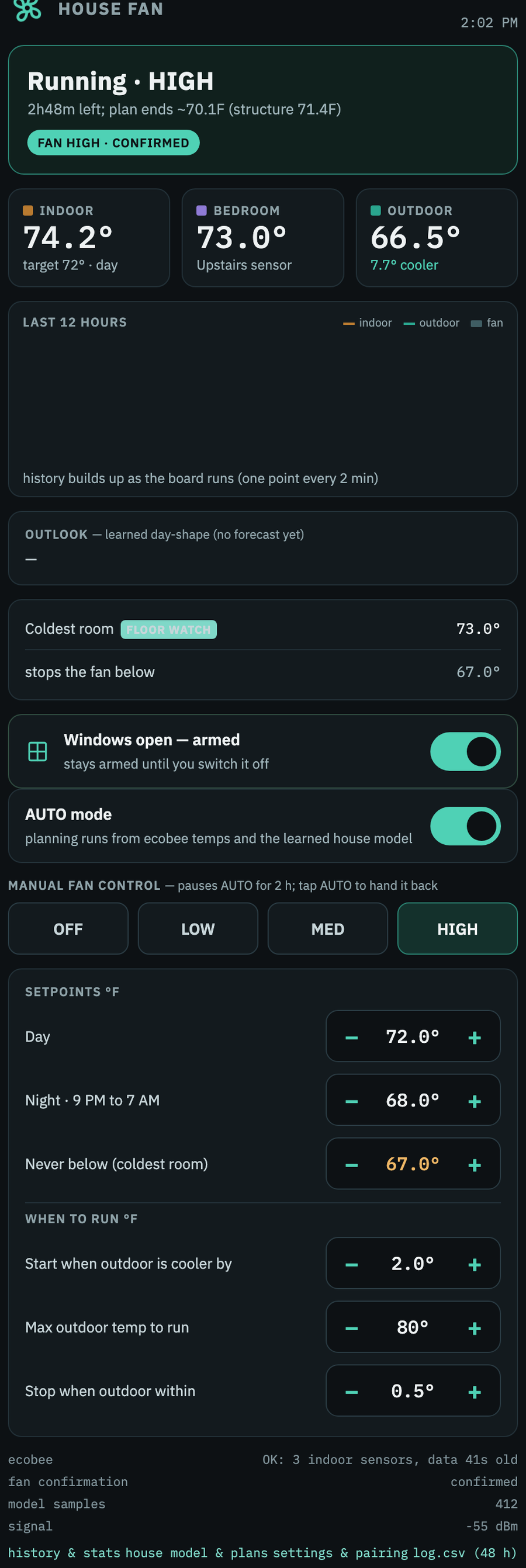
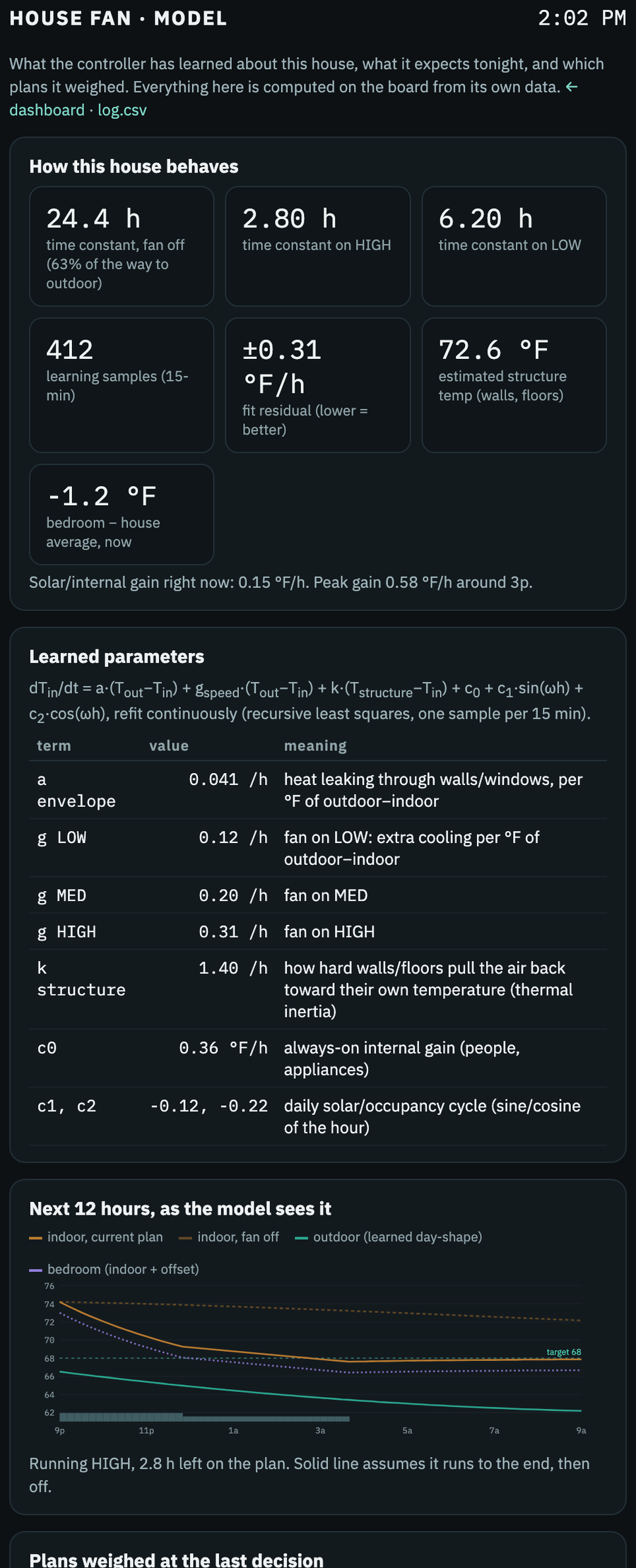
The board serves its own pages — no app and no cloud. The control dashboard shows status, temperatures, a manual override, and the setpoints. The model page shows what the controller has learned about the house and how it expects the night to run.
Where it is
fan_brain and a host simulator — a synthetic house and weather, AUTO versus a plain thermostat — build and run. The ecobee login, token refresh, and sensor read are tested against the real account, and the parser is unit-tested against a real response. The firmware compiles clean for the ESP32 (ESPHome 2026.9, 37% RAM, 64% flash). Next is running it on the board — antenna on before power, always, or you cook the transmitter — and moving the sensing over to UniFi Protect once the hardware is back in stock.
Links
- Built on ESPHome and esphome-quietcool.